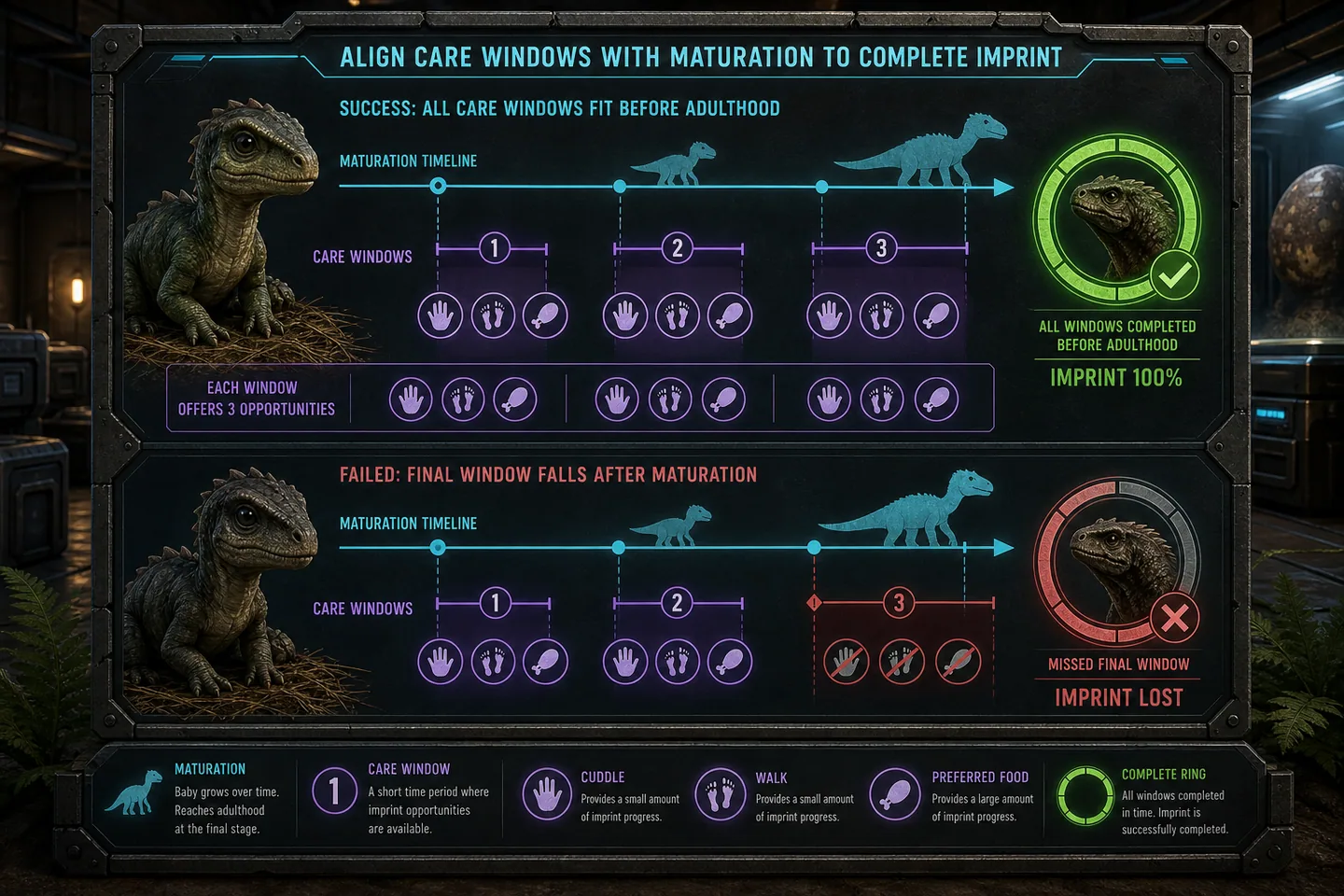
The common imprint failure is simple: maturation was accelerated, but the care schedule was not shortened enough. The baby reaches adulthood before enough requests occur, so no amount of waiting can finish the imprint. Fixing it requires treating BabyMatureSpeedMultiplier, BabyCuddleIntervalMultiplier and any imprint amount multiplier as one schedule rather than isolated sliders.
Species have different maturation times, which means a combination that works for a Rex may behave differently for a fast-growing creature. Test at least one short and one long maturation species before promising that every baby can reach 100%. Use a backup or disposable pair because changing rates during active growth can make existing timers confusing.

1. Understand the three parts of the schedule
BabyMatureSpeedMultiplier increases growth speed when raised. BabyCuddleIntervalMultiplier scales the default interval between care requests, so a lower number requests care sooner. BabyImprintAmountMultiplier scales how much percentage each completed interaction awards. Maturation controls the available window; interval controls how many opportunities fit; amount controls progress gained from each opportunity.
At default behavior, the care interval for ordinary non-mod creatures is based on eight hours, while total maturation varies by species. The game calculates imprint gain from the relationship between total maturation time and care interval. Extreme values can be clamped or produce edge cases, so use practical decimals and confirm the displayed timer in game.
2. Choose an adult time and care frequency
Start by deciding how long a representative baby should take to mature in active world time. Then decide how often a player can realistically return for care. A private evening server might target several interactions spaced far enough apart to play normally, while a short event may prefer one or two interactions. Do not begin by copying a large mature multiplier without a target adult time.
The first care request must occur before adulthood with enough remaining opportunities to reach 100%. Leave margin for random timing and late interaction rather than designing a schedule that works only when every click occurs instantly. Players sleep, servers restart and babies may be born at inconvenient times. A mathematically possible but unforgiving profile is not reliable.
3. Build a test combination
A common starting relationship is to reduce the cuddle interval as maturation speed increases. For example, a world using 10x maturation can begin testing around a 0.1 cuddle interval, but this is a test point rather than a guarantee for every species or Single Player Settings state. The single-player option applies additional breeding behavior and must be recorded with the result.
Keep BabyImprintAmountMultiplier at its baseline until timing works. Increasing the amount can reduce required interactions, but it can also turn every species into an instant 100% imprint and hide a broken interval. First ensure a request appears during maturation. Then decide whether the number of interactions suits the server’s intended effort.
[/script/shootergame.shootergamemode]
BabyMatureSpeedMultiplier=10.000000
BabyCuddleIntervalMultiplier=0.100000
BabyImprintAmountMultiplier=1.000000
4. Record a real birth-to-adult test
Breed a fast species and a slower species. Record birth time, adult time, the first Wants Care timer, percentage gained per care and the maximum total achieved. Do not use only a creature already growing when values changed. A fresh baby gives the configuration a clean start and makes the observation reproducible.
If no request occurs before adulthood, lower the cuddle interval or slow maturation. If requests occur but total progress remains below 100%, create more opportunities or increase imprint amount carefully. If 100% is reached almost immediately and that is not intended, reduce amount or increase interval. Restart once and repeat to confirm the configuration persists.
5. Account for care requests and server availability
Care may request a cuddle, walk or a food item. Prepare commonly requested foods and provide safe space for walking. A player arriving late reduces the remaining maturation window even when the interval itself is correct. Grace and quality-loss settings can make a schedule more forgiving, but they do not create a missing first request before adulthood.
On single player and non-dedicated worlds, growth progresses only while the world is active. On an always-running server it continues while the player is offline. The same numeric interval can therefore feel very different. Choose rates based on when the server runs and whether the community expects overnight breeding projects.
6. Change rates without damaging active projects
Warn players before changing breeding rates. Existing babies may have timers created under earlier settings, and a sudden mature-speed increase can push them to adulthood before the new care plan is understood. Save and back up, then test the change away from valuable bloodlines. Publish the mature, cuddle and amount values together so players can plan.
Recheck after enabling Single Player Settings, installing a breeding mod or changing event rates. Do not describe one combination as perfect for every server. A trustworthy configuration states the checkbox state, intended adult time, tested species and number of interactions, then leaves enough margin for normal human play.
Common questions
Frequently asked questions
Why does my baby mature before the first imprint?
Maturation is too fast for the current cuddle interval. Lower BabyCuddleIntervalMultiplier or reduce maturation speed, then test with a newly born baby.
Does 10x maturation always work with 0.1 cuddle interval?
It is a reasonable test relationship, not a universal guarantee. Species, event rates and Single Player Settings change the final schedule.
Should I raise BabyImprintAmountMultiplier first?
First make sure care requests occur before adulthood. Then adjust the amount if the tested number of interactions does not fit your intended experience.